
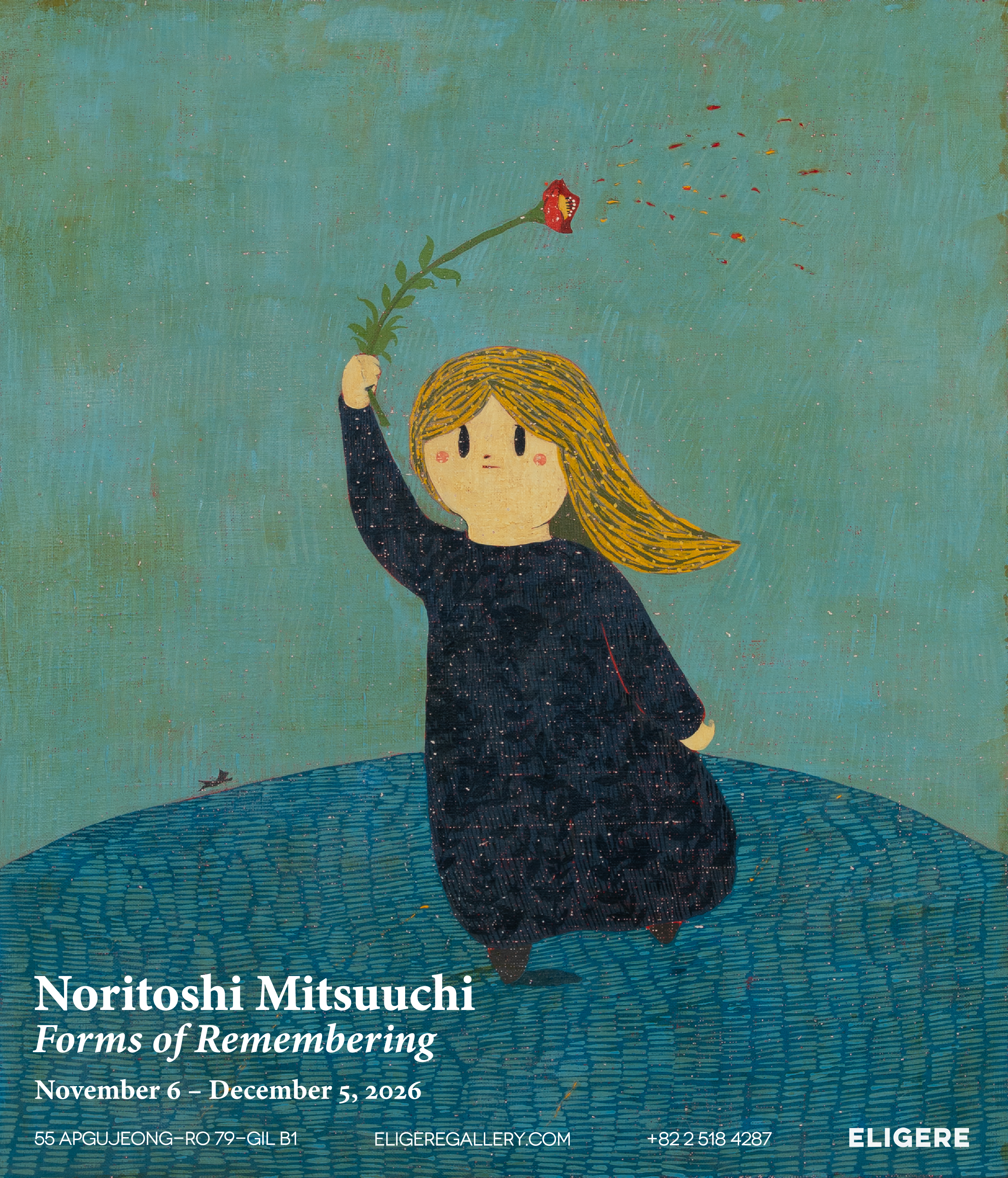
Born in Osaka, Japan, Noritoshi Mitsuuchi (b. 1978) studied at Kobe Design University and has exhibited his work since 2002. Through forms that recall children’s drawings, delicate lines, and vivid yet richly layered colour, he creates a painterly world in which memory, imagination, and emotion intersect. Figures resembling people, animals, plants, and spirits inhabit his canvases, their appearances fluid within spaces that hold familiarity and strangeness together.
A return to the sensibilities of childhood lies at the heart of Mitsuuchi’s practice. For him, childhood is closely bound to ways of seeing the world and making images. He seeks to set aside the complexities of thought and technique acquired in adulthood, approaching a way of looking in which feeling precedes reason. His belief that the pursuit of perfection in art can cause what matters most to disappear encapsulates this approach. His free brushwork and intuitive use of colour convey a desire to give pictorial form to the movement of emotion. His paintings can be understood as an encounter with childhood imagination through an adult sensibility, and as an attempt to recover a freedom that can recede amid the responsibilities of everyday life.
His visual language brings together elements drawn from popular culture and the art of the past. Its influences range from Japanese and Western cartoons, advertising, skateboarding, street culture, and traditional folk music to the paintings of Paul Klee and George Condo. Knights, princesses, dragons, and cats, evoking Japanese folk tales and European fairy tales, appear as embodiments of the artist’s own experiences and emotions. Through these figures, childhood fantasies take on renewed life in the present.
A dialogue with historical imagery is another essential foundation of his practice. His references include traditional Japanese picture scrolls such as the Chōjū-giga, while his placement of figures on clouds draws on the sculptures of bodhisattvas on clouds in the Phoenix Hall of Byōdō-in. Mitsuuchi attends to the subtle yet unmistakable beauty found within the vast history of art, seeking through it to awaken the viewer’s memory and imagination. In his combination of playfulness and close attention to detail, images passed down through generations find new expression in the language of contemporary painting.
Gallerist Bill Brady (1967–2023) played a part in bringing Mitsuuchi’s paintings to audiences in the United States. Brady opened ATM Gallery in New York’s East Village in 2001, later extending his activities to Kansas City, Miami, and Los Angeles. He earned the trust of the contemporary art community through his ability to recognise the promise of work that had yet to reach a wider audience, presenting Tomoo Gokita’s first New York solo exhibition and supporting Huma Bhabha early in her career. Discovering artists, accompanying their development, and creating opportunities for their work to meet an audience were central to his approach.
In 2023, Mitsuuchi presented Listen at Bill Brady Gallery in Miami and Listen II at ATM Gallery NYC in New York. Brady had co-founded the New York space with William Leung in 2020, with Leung overseeing its day-to-day operations. The two exhibitions brought Mitsuuchi’s paintings to a wider audience in the United States. On April 30 that year, however, Brady died from complications of asthma at the age of 55. That autumn, Listen III, the final chapter in the exhibition series, opened at Bill Brady Gallery in Los Angeles. In a space Brady had established during his lifetime, Mitsuuchi’s work continued to meet new audiences.
The following year, in 2024, Mitsuuchi dedicated his solo exhibition Poetic Stars at Ross + Kramer Gallery in New York to Bill Brady and Michel Cohen, founder of Collection Montparnasse. Cohen was a collector who actively acquired work by emerging artists and valued his exchanges with them. Honouring the two men’s lives and legacies, the dedication quietly acknowledges the relationships that have shaped the artist’s journey. Remembering through an exhibition the gallerist who had introduced his work to the world suggests how an encounter can endure within a creative life long after a person’s death. As the paintings reach new audiences, the memory of those the artist wished to honour continues alongside them.
In Mitsuuchi’s work, memory also extends into the viewer’s experience. The figures and scenes are familiar yet difficult to name precisely, resisting any single narrative or fixed meaning. Within this open space, viewers may recall their own experiences and emotions, encountering forgotten sensations or impressions that have yet to find words. The painted forms meet different memories in each viewer, giving rise to new stories. His paintings thus call forth the viewer’s memories, allowing them to open into new imaginings.
In the works presented in Bloom, the emergence and transformation of forms come more strongly to the fore. Suspended between childhood and adulthood, reality and fantasy, these beings are not confined to a particular age, role, or identity. Forms suggestive of plants, animals, spirits, and imagined creatures emerge from within one another, expanding, dispersing, and reappearing. Carrying emotional traces and fragments of memory, they feel at once intimate and distant. Within pictorial spaces where the order of time and space loosens, growth unfolds as a subtle process from within.
In this world, innocence coexists with unease, tenderness with violence, and softness with tension. These opposing qualities remain unresolved. Mitsuuchi embraces uncertainty in the making of a painting, allowing intuition and emotion to guide the development of its composition. Overlapping forms and shifting spaces hold viewers between comfort and discomfort, introducing ambiguity and tension even within imagery that recalls childhood.
The vulnerability of these beings also resonates with the experience of seeking a place within prescribed roles. His paintings can be read as spaces in which beings slightly out of step with the rhythms of the world, and feelings that resist easy definition, may briefly find a place. Uncertainty is accommodated, and those who remain undefined retain a presence of their own. Beginning with personal sensibility, his work connects in this way with contemporary experiences of identity, belonging, and finding one’s place in the world.
Through Forms of Remembering, ELIGERE considers how memory takes shape in painting through emotion and imagination. In Mitsuuchi’s canvases, childhood sensibilities, old stories, and cultural images carried across time find their way into the colours and lines of the present. The encounters that have marked the artist’s journey, and his wish to remember them, offer another context through which to approach these paintings. Their forms remain open to meaning, calling forth each viewer’s memories in the space between familiarity and strangeness. Poised between memory and imagination, these beings meet our own experiences and lead us into further stories.
노리토시 미츠우치(b. 1978)는 일본 오사카에서 태어나 고베예술공과대학에서 수학하고, 2002년부터 전시를 통해 작품을 선보여 왔다. 어린아이의 그림을 연상시키는 형태와 섬세한 선, 선명하면서도 깊이 있는 색채를 통해 기억과 상상, 감정이 교차하는 회화 세계를 구축한다. 그의 화면에는 인물과 동물, 식물과 정령을 닮은 존재들이 등장하며, 친밀함과 낯섦이 공존하는 공간 속에서 유동적인 모습을 드러낸다.
미츠우치의 작업을 관통하는 태도는 유년의 감각으로 돌아가는 데 있다. 그에게 유년은 세계를 바라보고 그림을 만들어가는 방식과 깊이 연결된다. 작가는 성인이 되며 익힌 복잡한 사고와 기교를 덜어내고, 감정이 논리보다 먼저 움직이던 시선에 다가가고자 한다. 예술을 완벽하게 만들려 할수록 정작 중요한 것들이 사라진다는 그의 생각은 이러한 태도를 함축한다. 자유로운 붓질과 직관적인 색채에는 감정의 움직임을 화면에 남기려는 의지가 담겨 있다. 그의 회화는 어린아이의 상상력을 성인의 감각으로 다시 마주하는 과정이며, 일상의 책임 속에서 멀어지기 쉬운 유년의 자유로움을 되찾으려는 시도로 읽힌다.
그의 시각 언어에는 대중문화와 오래된 미술에서 비롯된 요소들이 함께 자리한다. 일본과 서양의 만화, 광고, 스케이트보딩과 거리문화, 전통 민속음악을 비롯해 파울 클레와 조지 콘도의 회화까지 다양한 영향이 스며 있다. 기사와 공주, 용과 고양이처럼 일본의 민담과 유럽의 동화를 연상시키는 존재들은 작가 자신의 경험과 감정을 대신하는 모습으로 등장한다. 이들은 유년의 환상을 오늘의 감각으로 다시 살아나게 한다.
오래된 이미지와의 대화 역시 그의 작업을 이루는 중요한 바탕이다. 일본의 회화 두루마리 《조주기가》와 같은 전통적 이미지가 참조되며, 구름 위에 형상을 배치하는 발상은 뵤도인 봉황당의 운중공양보살상에서 비롯됐다. 작가는 방대한 미술의 역사 속에 미묘하지만 분명하게 존재하는 아름다움에 주목하고, 이를 통해 관객의 기억과 상상력을 자극하고자 한다. 유희적인 미감과 세부를 살피는 섬세함 속에서, 오랜 시간 전해져 온 이미지들은 동시대 회화의 언어로 새로운 모습을 얻는다.
미츠우치의 회화가 미국 관객과 만나는 과정에는 갤러리스트 빌 브래디(Bill Brady, 1967–2023)와의 인연이 자리한다. 브래디는 2001년 뉴욕 이스트빌리지에 ATM 갤러리를 열고, 이후 캔자스시티와 마이애미, 로스앤젤레스 등으로 활동을 넓혔다. 고키타 도모오의 첫 뉴욕 개인전을 선보이고 후마 바바의 초기 활동을 지원하는 등, 아직 널리 알려지지 않은 작업의 가능성을 알아보는 안목으로 동시대 미술계에서 신뢰를 얻었다. 새로운 작가를 발견하고 그들의 성장을 함께하며, 작품이 관객과 만날 자리를 마련하는 일은 그의 활동을 관통하는 태도였다.
2023년 미츠우치는 마이애미의 빌 브래디 갤러리에서 《Listen》을, 뉴욕의 ATM Gallery NYC에서 《Listen II》를 선보였다. 뉴욕의 공간은 브래디가 2020년 윌리엄 렁과 공동 설립한 갤러리로, 렁이 일상 운영을 맡았다. 두 전시는 미츠우치의 회화가 미국 관객과 만나는 접점을 넓혔다. 그러나 그해 4월 30일, 브래디는 천식 합병증으로 55세에 세상을 떠났다. 같은 해 가을에는 로스앤젤레스의 빌 브래디 갤러리에서 연작 전시의 마지막 장인 《Listen III》가 열렸다. 그가 생전에 마련한 전시 공간에서 작가의 작업은 계속 관객을 만났다.
이듬해인 2024년, 미츠우치는 뉴욕 로스 앤 크레이머 갤러리에서 열린 개인전 《Poetic Stars》를 갤러리스트 빌 브래디와 컬렉시옹 몽파르나스(Collection Montparnasse)의 설립자 미셸 코언에게 헌정했다. 코언은 신진 작가의 작품을 적극적으로 수집하며 작가들과의 교류를 중시했던 컬렉터다. 두 사람의 삶과 그들이 남긴 뜻을 기리는 이 헌정은 작가의 여정에 남은 인연을 조용히 드러낸다. 자신의 작품을 세상에 소개했던 갤러리스트를 전시를 통해 기억하는 행위는, 한 사람과의 만남이 그가 떠난 뒤에도 창작의 시간 속에 남을 수 있음을 생각하게 한다. 작품이 새로운 관객을 만나는 자리에서, 작가가 기리고자 했던 이들에 대한 기억도 이어진다.
그의 작업에서 기억은 관객 안에서 일어나는 경험으로도 확장된다. 화면 속 존재와 장면은 익숙하면서도 정확히 이름 붙이기 어렵고, 하나의 이야기나 의미로 고정되지 않는다. 관객은 이 열린 공간에서 각자의 경험과 감정을 떠올리며, 잊고 있던 감각이나 아직 언어가 되지 않은 인상을 마주할 수 있다. 작품 속 형상은 저마다 다른 기억과 만나 새로운 이야기를 만들어낸다. 그의 회화는 그렇게 관객의 기억을 불러내고, 그 기억이 새로운 상상으로 이어지는 자리를 마련한다.
《Bloom》에서 선보인 작업에서는 형상이 생겨나고 변화하는 과정이 더욱 부각된다. 아이와 어른, 현실과 환상 사이에 놓인 존재들은 특정한 나이나 역할, 정체성에 고정되지 않는다. 식물과 동물, 정령과 상상의 생명체를 연상시키는 형상은 서로의 안에서 피어나고, 확장되고, 흩어졌다가 다시 나타난다. 감정의 흔적과 기억의 파편을 품은 이 존재들은 친밀하면서도 멀게 느껴진다. 시간과 공간의 질서가 느슨해진 화면에서 성장은 내면으로부터 섬세하게 펼쳐지는 과정으로 나타난다.
그 세계에는 순수함과 불안, 다정함과 폭력성, 부드러움과 긴장이 함께 자리한다. 상반된 감각들은 어느 한쪽으로 해소되지 않은 채 공존한다. 작가는 제작 과정의 불확실성을 받아들이고, 직관과 감정이 구도의 전개를 이끌도록 한다. 겹쳐지는 형상과 변화하는 공간은 관객을 편안함과 불편함 사이에 머물게 하며, 유년을 떠올리게 하는 이미지 안에서도 모호함과 긴장을 느끼게 한다.
이러한 존재들의 취약성은 정해진 역할 속에서 자신의 자리를 찾으려는 감각과도 맞닿아 있다. 그의 회화는 세상의 리듬과 조금 어긋난 존재들, 쉽게 이름 붙일 수 없는 감정들이 잠시 머물 수 있는 공간으로 읽힌다. 그 안에서는 불확실함도 받아들여지고, 명확하게 규정되지 않은 존재도 자신만의 모습을 지닌 채 남는다. 개인적인 감각에서 출발한 작업은 이처럼 정체성과 소속감, 세계 안에서 자신의 자리를 찾아가는 동시대의 경험으로 연결된다.
엘리제레는 《기억의 형상》을 통해 기억이 감정과 상상을 거쳐 회화 속에서 모습을 얻는 과정에 주목한다. 미츠우치의 화면에는 유년의 감각과 오래된 이야기, 시간을 건너온 문화적 이미지가 현재의 색과 선으로 스며든다. 작가의 여정에 남은 만남과 이를 기억하는 마음도 이 회화를 바라보는 하나의 배경이 된다. 그 안에서 형상은 하나의 의미에 머무르지 않고, 익숙함과 낯섦 사이에서 관객 각자의 기억을 불러낸다. 기억과 상상 사이에 놓인 존재들은 그렇게 우리의 경험과 만나 또 다른 이야기로 이어진다.